
Notice of Default: First Step to Foreclosure
A notice of default is the document a lender records to start a non-judicial foreclosure. What it must contain, the timeline it triggers, and how investors use it.
What a notice of default is
A notice of default (NOD) is the document a lender records with the county to formally begin a non-judicial foreclosure — the power-of-sale process used in many states where the lender does not have to file a lawsuit. It is the opening move: the public, dated declaration that a borrower has fallen behind and the lender intends to sell.
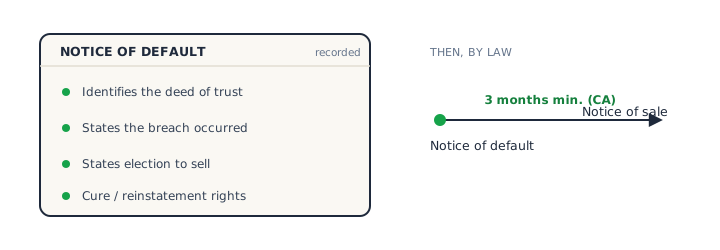
California’s statute is a clear model. Under Civil Code section 2924 (accessed July 2026), a notice of default must include a statement identifying the mortgage or deed of trust, “a statement that a breach of the obligation … has occurred,” and “a statement setting forth the nature of each breach … and of the beneficiary’s election to sell or cause to be sold the property.”
The timeline it starts
Recording an NOD starts a clock, and the clock is set by law.
- Federal floor: the Consumer Financial Protection Bureau states that “the legal foreclosure process can’t start until you are at least 120 days behind on your mortgage” (accessed July 2026). That 120-day delinquency generally comes before the NOD.
- State step: in California, Civil Code section 2924 requires that “not less than three months shall elapse from the filing of the notice of default” before a notice of sale can be given (accessed July 2026).
Timelines differ by state, but the shape is consistent: delinquency, then a recorded default, then a waiting period, then a sale notice.
Notice of default vs lis pendens
An NOD belongs to non-judicial foreclosure. Where a state forecloses through the courts (judicial foreclosure), you instead see a lis pendens — notice that the lender has filed a lawsuit. Same underlying event, different legal machinery. Which document appears tells you which process the state uses.
What it means for investors
An NOD is one of the earliest public signals in the pre-foreclosure timeline, which is exactly why investors watch it. The owner still has time and options, so there is room to reach out before the auction pressure peaks. As always, the value is in the recording date and verifying the record against its primary source, per our methodology; the free, county-by-county method is walked through in where pre-foreclosure data comes from.
If pulling records from each county by hand does not scale, field-and-data tools aggregate them for a fee — our DealMachine review covers one option honestly, including where the free route is enough.
Sources
- California Civil Code section 2924 (FindLaw) (notice of default contents and timeline; accessed July 2026)
- Consumer Financial Protection Bureau — foreclosure timeline (120-day rule; accessed July 2026)
Frequently asked questions
- What is a notice of default?
- A notice of default (NOD) is a document a lender records with the county to start a non-judicial foreclosure after a borrower misses payments. Under California Civil Code section 2924 it must identify the deed of trust, state that a breach occurred, and state the lender's election to sell the property.
- How long after a notice of default before the house is sold?
- It varies by state. In California, Civil Code section 2924 requires that not less than three months pass from the filing of the notice of default before a notice of sale can be given, and a separate notice of sale period follows. Federal rules also generally bar starting foreclosure until the borrower is 120 days delinquent.
- Is a notice of default public record?
- Yes. It is recorded with the county recorder or clerk, the same office that holds deeds and mortgages, which is why investors and data vendors can find it. The recording date is the true age of the lead.
- What is the difference between a notice of default and a notice of sale?
- The notice of default starts the process and states the breach. The notice of sale comes later and sets the actual auction date. In California a notice of sale cannot be given until at least three months after the notice of default is recorded.
- Does a notice of default mean the home will be foreclosed?
- Not necessarily. The notice of default opens the pre-foreclosure window, during which the owner can reinstate the loan, negotiate a workout, or sell. Many defaults are cured or resolved before any sale takes place.
How this page was researched and verified: read the methodology. Found something out of date? Tell us.
Get the REI software pricing tracker
A dated log of what these tools actually cost, updated as prices change. No spam, unsubscribe anytime.
Double opt-in. We never sell the list. See our privacy policy.