
How to Find Tax Delinquent Properties (Free)
A tool-agnostic walkthrough of finding tax-delinquent properties free from public county records, the tax lien vs tax deed difference, and when a paid list is worth it.
You find tax delinquent properties free at the county tax collector or treasurer. Every county keeps a public list of owners behind on property taxes, and most are required by statute to publish it — in the local newspaper and usually online. Pull that list, cross-reference each parcel against the assessor’s records, and reach owners early, while there is still room to make a deal before the county’s tax sale.
That is the method. Below is the full click-path, the one distinction that changes your whole play (tax lien states versus tax deed states), and the honest math on when a paid list is worth it.
What “tax delinquent” actually means
A tax-delinquent property is one whose owner has fallen behind on property taxes. That status is a public record, and the list of those owners is the lead. The reason it signals motivation: unpaid taxes often travel with the other things that make an owner ready to sell — a vacancy, a tired landlord, an inherited property nobody wants, or an out-of-area owner who has stopped paying attention.
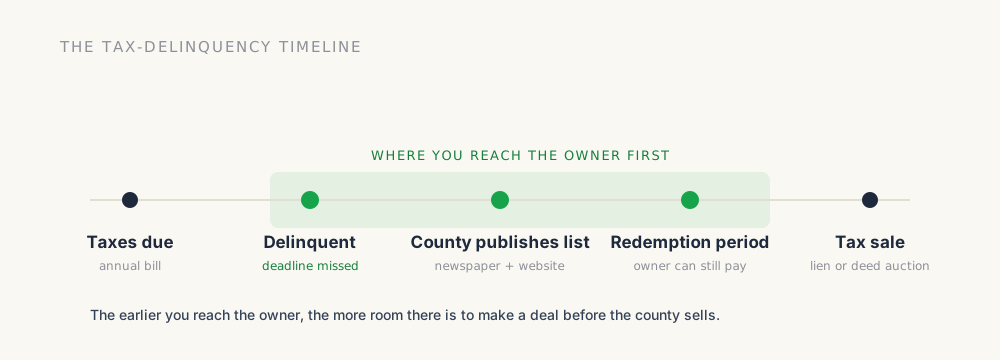
The important nuance most guides skip: delinquent does not mean the property is at auction yet. Delinquency starts the moment a payment deadline passes; the county’s tax sale can be months or years later. That gap is the lead window. Reaching the owner early — after they are delinquent but well before the sale — is where an off-market deal is possible.
Counties are generally required to make this public. Minnesota statute, for example, mandates that the county publish the delinquent tax list in its official newspaper and make it available in the county auditor’s office (Minn. Stat. 279.09). North Carolina requires counties to advertise tax liens on real property by posting at the courthouse and publishing in a newspaper of general circulation (N.C. Gen. Stat. 105-369). In California, the county issues a Notice of Delinquency under the Revenue and Taxation Code (Los Angeles County, Notice of Delinquency). In Texas, delinquency and its collection are governed by Tax Code Chapter 33 (Texas Tax Code Ch. 33). The vocabulary varies by state; the public-record status does not.
Why tax-delinquent owners come to the table
Falling behind on taxes is rarely the whole story — it is usually a symptom. The owner may have moved and let the property drift, inherited a house they cannot maintain, run a rental into the ground, or simply run short on cash. The county adds a clock the other distress signals lack: keep not paying, and the property is eventually sold for the taxes. That deadline is real, and it makes a straightforward offer to buy genuinely useful to an owner who is stuck. Approach it that way — as a way out for someone who needs one — not as a countdown to exploit.
For how this signal sits next to the others, see the companion guides on absentee owners, probate leads, and where pre-foreclosure data comes from.
The free public-records method, step by step
No subscription required. This is the part the list-sellers compress into one line.
1. Find the county tax collector or treasurer. Search [your county] delinquent tax list or [your county] tax collector. This is the office that bills and collects property taxes; it is separate from the assessor (who values the property). Bookmark the actual delinquent-list or tax-sale page, not the homepage. Harris County, Texas — the largest market we track — publishes both a delinquent-tax search and a tax-sale listing through its tax office (Harris County Tax Office: tax sales).
2. Get the list. Counties surface it in a few ways: a published newspaper notice, an online search or downloadable file, and sometimes a state-level inventory. Alabama, for instance, maintains a by-county listing of tax-delinquent property in state inventory, with transcripts updated weekly (Alabama Department of Revenue). Many county tax offices, like Mecklenburg County, North Carolina, post delinquent-taxpayer lists directly (Mecklenburg County Tax Collector). If yours only publishes in the newspaper, the paper’s legal-notices section carries it.
3. Read the list for what matters. Prioritize by years delinquent (more years usually means more distress and a closer sale date) and amount owed relative to value (a small balance against a valuable house is an owner with room to sell). Skip the records that are clearly a temporary oversight by an otherwise-current owner.
4. Cross-reference to the assessor. The collector’s list tells you who owes; the county assessor or appraisal district tells you about the house. Look up each parcel to capture the parcel ID, assessed value, the owner’s mailing address, and whether there is a homestead exemption. This is the same public-records cross-check our methodology is built on.
5. Estimate equity and qualify. Compare assessed or market value against any recorded mortgage or liens in the recorder’s records. High equity, several years delinquent, and an out-of-area mailing address is the combination most likely to transact.
Tax lien versus tax deed: this changes your play
Before you work a list, know which system your state uses, because it changes what the county is actually selling and how much time the owner has.
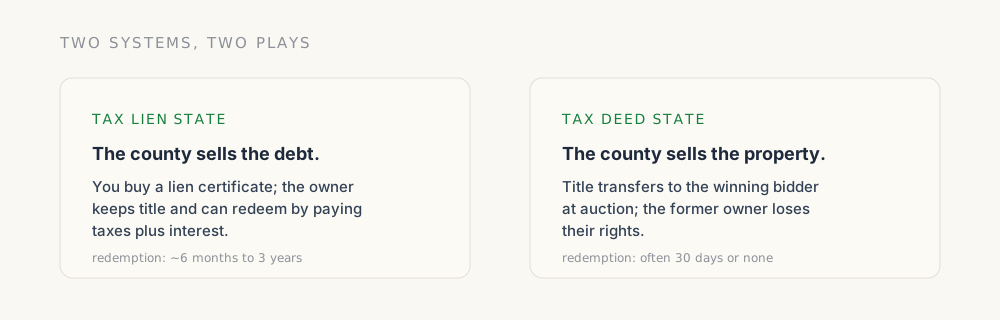
In a tax lien state, the county sells the debt as a lien certificate; the owner keeps title and can redeem by paying the back taxes plus interest, with redemption periods that commonly run from about six months to three years (Tax Title Services: redemption periods). In a tax deed state, the county sells the property itself at auction, and redemption is often as short as 30 days or does not exist at all (Tax Title Services). The mechanics of buying at the sale differ (Pacific Legal: deeds versus liens).
For off-market acquisition the takeaway is the same in both: the deal is in reaching the owner during delinquency, before the sale, not in the auction itself. The lien-versus-deed distinction mostly tells you how much runway the owner has and how the county’s process will unfold if no one steps in.
Respectful, compliant outreach
Once you have a name and a mailing address, outreach is usually direct mail or a call. A few rules:
- Lead with the solution. These owners are often under financial strain. Offer a clean way to sell and settle the taxes; do not open with the delinquency itself.
- Mail to a current address. Tax-roll addresses go stale. Run mailing addresses through USPS NCOALink, the postal service’s dataset of roughly 160 million permanent change-of-address records that updates lists before you mail (USPS PostalPro: NCOALink). Cleaner addresses mean less wasted postage.
- Mind calling rules. If you phone, follow TCPA and state calling-time and consent rules, and honor a do-not-contact request on the first ask.
- Time it sensibly. Reaching out early in the delinquency is both more respectful and more productive than appearing the week before the sale.
Paid tools versus free: the honest math
The free method wins when you work one county and have a few hours a week. The data on any paid tax-delinquent list is this same public record, aggregated and re-sold.
Paid tools earn their fee at the points the free method breaks:
- Phone and email at volume. The county gives you a name and a mailing address, not a cell number. Appending contact data is skip tracing, usually priced per record, and it does not scale by hand.
- Many counties at once. Pulling and normalizing delinquent lists across dozens of counties is a part-time job; aggregation is what these platforms sell.
- Filtering and list stacking. Layering equity, owner-occupancy, and years-delinquent across stacked lists is slow manually and fast in software.
Run the numbers before subscribing: estimate the qualified leads a county yields in a month, value the hours it would take to pull them, and compare that to the list price. For one county the free method usually wins; across many counties, or when you need phone numbers at volume, paying usually does. We keep tool-by-tool breakdowns tool-neutral on the compare page and define the terms in the learn hub — there is no list to sell here.
Frequently asked questions
How do I find tax delinquent properties for free? Go to your county tax collector or treasurer, get the published delinquent-tax list (online, by request, or from the newspaper’s legal notices), then cross-reference each parcel in the county assessor’s records. These are public records (Mecklenburg County Tax Collector; Alabama Department of Revenue).
Are tax delinquent property lists public record? Yes. Counties are generally required by statute to publish them; Minnesota mandates newspaper publication and county-office availability (Minn. Stat. 279.09), and North Carolina requires advertising tax liens at the courthouse and in a newspaper (N.C. Gen. Stat. 105-369).
What is the difference between a tax lien and a tax deed? In a tax lien state the county sells the debt (a lien certificate) and the owner keeps title and can redeem; in a tax deed state the county sells the property itself at auction, often with a short redemption window or none (Tax Title Services).
When is the best time to contact a tax-delinquent owner? Early in the delinquency, after the status is public but well before the tax sale. That is when the owner still has room to sell on their own terms rather than lose the property at auction.
Do I need to buy a list, or can I pull it myself? For a single county you can pull it yourself free from the tax office and assessor. Paying makes sense when you need phone numbers appended at volume (skip tracing) or you work many counties and cannot pull and cross-reference everything by hand.
Sources
- Minnesota Statute 279.09 (Delinquent Tax Manual) — publication of the delinquent tax list (verified June 2026)
- North Carolina General Statute 105-369 — advertisement of tax liens (verified June 2026)
- Los Angeles County — Notice of Delinquency — California Revenue and Taxation Code delinquency notice (verified June 2026)
- Texas Tax Code Chapter 33 — Delinquency (verified June 2026)
- Harris County Tax Office — Tax Sales — delinquent and tax-sale listings (verified June 2026)
- Alabama Department of Revenue — Tax Delinquent Property and Land Sales — state inventory updated weekly (verified June 2026)
- Mecklenburg County Tax Collector — Delinquent Taxpayer Lists (verified June 2026)
- Tax Title Services — Redemption Periods for Tax Sales — lien vs deed redemption ranges (verified June 2026)
- Pacific Legal — Deeds versus Liens (verified June 2026)
- USPS PostalPro — NCOALink (verified June 2026)
This article is structured desk research: public records, state statutes, and primary government sources, cited and dated. It is not legal or tax advice. Tax-sale systems, redemption periods, records access, and outreach rules vary by state and county; verify the rules for your jurisdiction.